

SIP vs Lump Sum Investment: Which Is Better in 2026?
You’ve got money ready to invest. The only question left is whether to drip it in slowly or put it all in at once. Here’s how to actually decide.
This question comes up more than almost any other: “I have ₹5 lakh — should I invest it all today, or spread it out?” There’s no one-size-fits-all answer, but there is a clear way to think about it, once you understand what each approach is actually doing with your money.
What Is a SIP and How Does It Work?
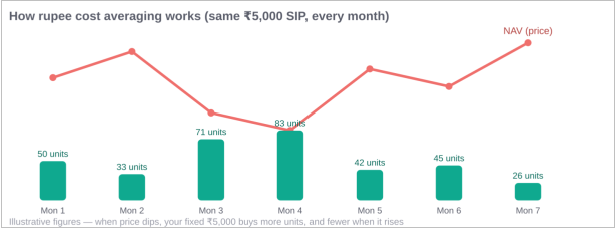
A Systematic Investment Plan (SIP) lets you invest a fixed amount — say ₹5,000 — every month into a mutual fund, automatically. You’re not trying to guess whether the market is high or low today; you’re just showing up, every month, rain or shine. Some months you’ll buy units when prices are low, some months when they’re high, and over time that averages out.
This is often called rupee cost averaging, and it’s the quiet engine behind why SIPs work so well for most people.
What Is a Lump Sum Investment?
A lump sum investment means putting your entire amount — the full ₹5 lakh — into the market in one shot, on one specific day. If the market rises after that, great, your entire investment benefits. If it falls right after, your entire investment feels that fall too. There’s no averaging cushion here; the timing of that one day matters a lot more than it does with a SIP.
SIP vs Lump Sum — Key Differences
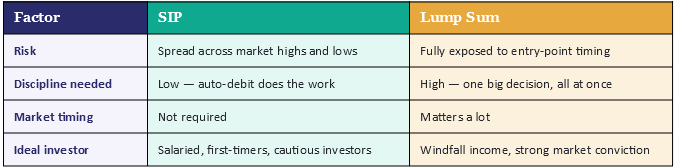
Here’s how the two stack up on the factors that actually matter when you’re deciding:
When Does SIP Make More Sense?
Salaried individuals with monthly income
If money enters your account every month, it makes sense for it to leave in the same rhythm. A SIP mirrors your income pattern instead of asking you to set aside a lump sum you may not have sitting around.
Volatile or uncertain markets
When markets are choppy and nobody — not even the experts — can confidently call the bottom, spreading your investment out reduces the damage of one badly timed entry.
First-time investors
If you’re new to investing, a SIP is far more forgiving of nerves. You’re not staring at one big number wondering if you got the timing wrong; you’re building a habit, one instalment at a time.
When Does Lump Sum Make More Sense?
Windfall income (bonus, inheritance, or sale proceeds)
If you suddenly have a large sum — a year-end bonus, an inheritance, proceeds from selling property — there’s a real cost to leaving it idle in a savings account for months while you drip it in slowly. In this case, investing it as a lump sum (or over a short window) may be more efficient, especially if it’s earmarked for a long-term goal.
Strong conviction on market entry point
If you have a well-researched view that valuations are attractive right now — after a sharp correction, for instance — a lump sum lets you act on that conviction fully, rather than diluting it across many months
A Hybrid Approach: STP (Systematic Transfer Plan)
You don’t have to pick a side. A Systematic Transfer Plan lets you park your lump sum in a low-risk debt or liquid fund, and then automatically move a fixed amount into an equity fund every month — essentially giving yourself SIP-style averaging, but starting from money that’s already invested and earning something, rather than sitting untouched in a savings account.
It’s a popular middle ground for people who’ve just received a large sum and don’t want to sit on it, but also don’t want to take on full lump-sum risk.
Real Example: ₹5 Lakh — SIP vs Lump Sum Over 5 Years
₹5 LAKH — HYPOTHETICAL 5-YEAR OUTCOME
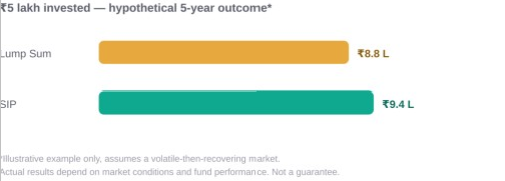
Notice the caveat: this outcome flips depending on the market’s path. In a market that rises steadily without much volatility, lump sum usually comes out ahead, because more of your money was invested for longer. The point isn’t that one strategy always wins — it’s that SIP protects you from bad luck on entry timing, while lump sum rewards good timing (and long, steady growth periods) more fully.
How Unicorn Finances Helps You Decide
The right answer depends on where your money is coming from, how soon you’ll need it, and how you personally handle market ups and downs — not just on historical averages. At Unicorn Finances, we look at your specific situation, whether that’s a monthly salary, a bonus, or a mix of both, and help you build an investment approach — SIP, lump sum, STP, or a blend — that fits your goals and your comfort level, not a generic rule of thumb.
Not sure whether to SIP it or go all in?
Whether you’re investing your first ₹5,000 or a windfall bonus, we’ll help you choose a strategy that actually fits your goals and comfort with risk.
Leave A Comment