

Mid-year financial planning – halfway through the year is the perfect natural pause point to ask: is my money actually working the way I planned it to? Markets move, salaries change, life happens — and a portfolio built in January can drift quietly out of shape by July without you noticing.
You don’t need a full financial overhaul. A focused, one-hour mid-year review across five areas — portfolio allocation, SIP goal, insurance, and emergency funds — is usually enough to course-correct before the year runs out. Here’s exactly what to check.
1. Review & Rebalance Your Portfolio
Markets rarely move in a straight line, and after a strong equity rally, your portfolio can end up far riskier than you intended — simply because your equity holdings grew faster than your debt or gold allocation.
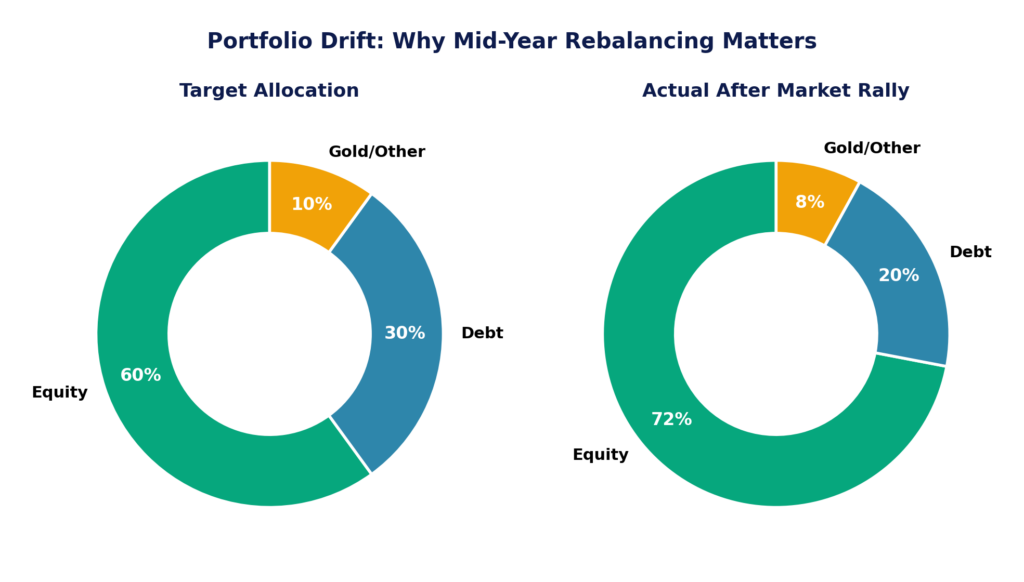
you making a single new investment.
Signal to Watch | What It Means | Action to Take |
Equity allocation up 10%+ vs target | Market rally has skewed your risk profile | Book partial profits, rebalance into debt/gold |
One fund is 30%+ of portfolio | Concentration risk from a single scheme | Diversify into other categories or fund houses |
Debt allocation shrunk sharply | Portfolio has become more aggressive than planned | Top up debt/hybrid funds to restore balance |
2. Check In on Your SIPs & Long-Term Goals
A mid-year check is the ideal time to ask: is my SIP amount still enough for my goal, given inflation and any change in my income? Small, boring adjustments now compound into a very different outcome later.
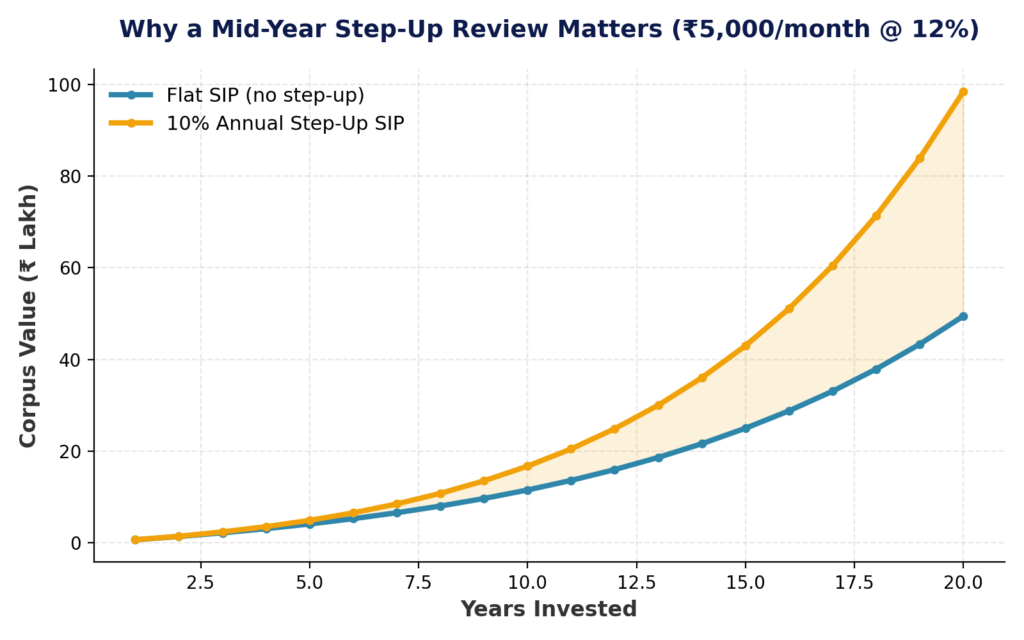
Situation | Mid-Year Action |
Got a salary hike this year | Increase your SIP amount or set up a step-up SIP |
SIP has been flat for 2+ years | Review if it still meets your goal given inflation |
A fund has underperformed its category for 2+ years | Evaluate switching — don’t react to one bad quarter |
Goal timeline has shifted (e.g. earlier home purchase) | Reassess if your asset mix still fits the new horizon |
3. Revisit Insurance & Protection Needs
Insurance is the part of a financial plan most people set up once and never look at again — even as income, dependents, and liabilities change. A mid-year check is a good reminder to confirm your cover still matches your life.
Has your income or loan liability (home loan, etc.) increased since you last reviewed your term cover?
Have you added a dependent (child, ageing parent) who now needs to be factored into your cover?
Is your health insurance sum insured still realistic given rising medical inflation?
Are your nominee details across policies and investment accounts up to date?
4. Top Up Your Emergency Fund
If you dipped into your emergency fund earlier in the year, mid-year is the time to rebuild it — before, not after, the next unplanned expense.
Emergency Fund Check | Ideal Target |
Coverage in months of expenses | 6–9 months for salaried; 9–12 months for variable income |
Where it’s parked | Liquid fund, sweep-in FD, or high-interest savings — not locked-in investments |
Last time it was used or topped up | Review and replenish at least once every 6 months |
Your Mid-Year Checklist at a Glance
# | Area | Ask Yourself |
1 | Portfolio Allocation | Has my equity:debt:gold mix drifted from target? |
2 | Is my SIP amount still enough for my goal today? | |
3 | Insurance | Does my cover still match my income, loans and dependents? |
4 | Emergency Fund | Do I have 6–9 months of expenses set aside and accessible? |
FAQs
Q: How often should I review my investment portfolio?
A full review twice a year — mid-year and year-end — is generally sufficient for most investors. Avoid reacting to every month’s market movement.
Q: Should I rebalance every time my allocation drifts slightly?
No. Minor drift (2–3%) is normal. Consider rebalancing once the drift crosses roughly 8–10% from your target allocation.
Q: What if my portfolio review shows I’m behind on a goal?
You generally have three levers: increase your SIP amount, extend the goal timeline, or adjust the goal itself. A financial advisor can help find the right combination.
Conclusion
A mid-year review isn’t about overhauling your entire financial life — it’s about catching small drifts before they become big problems. Twenty minutes spent checking your portfolio allocation, SIP amounts, insurance, and emergency fund today can save you from a stressful scramble in the last quarter of the year.
Ready for Your Mid-Year Portfolio Checkup
Leave A Comment