

Ask ten Indians how much they need to retire and you will hear ten different answers, from “one crore should do it” to “I’ll just depend on my children.” Neither is a plan. The truth is that your retirement number is personal, but it is never a mystery. With a few simple steps, you can work it out in an afternoon.
In this guide, we break down what a comfortable retirement really costs in India, how inflation quietly changes the maths, and how much you should invest every month to get there. If you are just getting started, our beginner’s guide to retirement planning is a good companion read.
What Does "Comfortable" Actually Mean?
Comfort looks different for everyone. For one family it is a paid-off home, simple meals and a yearly pilgrimage. For another it is travel, a good health cover and the freedom to help the grandchildren with their fees. Before you chase a number, write down the life you want at 60 and beyond.
A useful rule of thumb: most retirees spend about 70 to 80 per cent of their pre-retirement expenses. Your commute and EMIs may disappear, but healthcare and leisure costs rise. Plan for a lifestyle you can sustain for 25 to 30 years, because people are living longer than ever.
The Silent Thief: Inflation
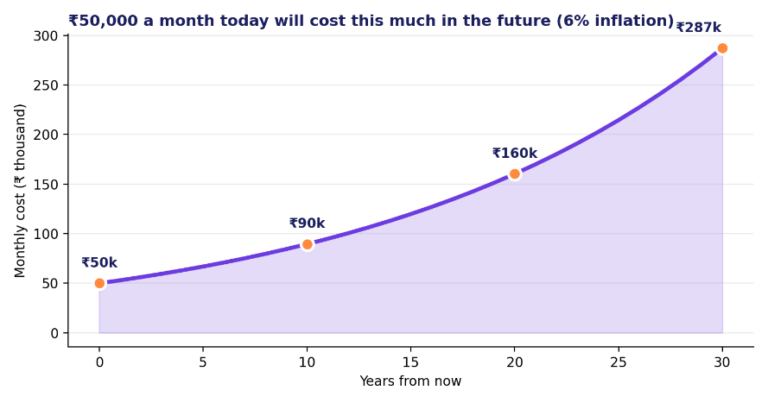
Here is what surprises most people. If you spend ₹50,000 a month today, you will need roughly ₹2.87 lakh a month in 30 years, assuming 6 per cent inflation. Your lifestyle has not changed. Only the price tag has.
– Home loan EMI: approximately ₹41,656/month
– Equivalent rent (at 3% yield): approximately ₹15,000/month
– Monthly gap between EMI and rent: approximately ₹26,656
A Simple Formula to Find Your Retirement Corpus
You do not need a finance degree for this. Follow three steps:
Step 1: Take your current monthly expenses and grow them by 6 per cent a year until retirement.
Step 2: Multiply the retirement-year monthly figure by 12 to get your annual expense.
Step 3: Multiply that by 25. This is the popular 4 per cent rule, which lets you withdraw 4 per cent a year while the rest keeps growing.
Because Indians often retire earlier and live longer, many planners prefer a more cautious multiple of 28 to 30. If you want a safety cushion, use it.
What the Numbers Look Like
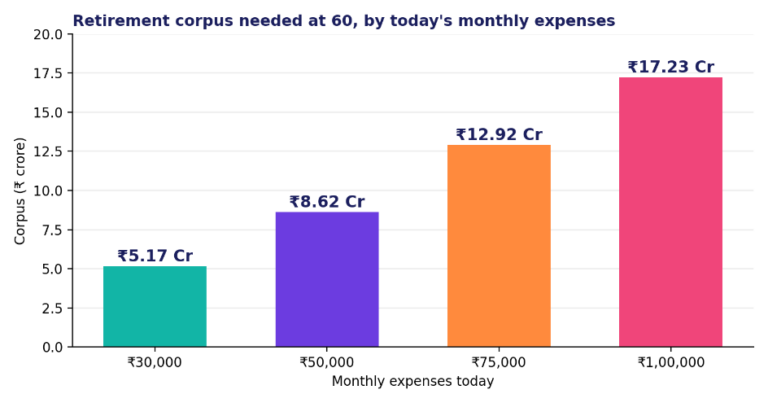
Monthly expense today | Monthly expense at 60 | Corpus needed (25x) |
₹30,000 | ₹1.72 lakh | ₹5.2 crore |
₹50,000 | ₹2.87 lakh | ₹8.6 crore |
₹75,000 | ₹4.31 lakh | ₹12.9 crore |
₹1,00,000 | ₹5.74 lakh | ₹17.2 crore |
– Home buyer’s net worth after 20 years: property value grown to ~₹1.92 crore (at 6% annual appreciation), loan fully repaid
– Renter’s net worth after 20 years: down payment + monthly SIP of the EMI–rent gap grown to ~₹3.82 crore (at 12% CAGR)
On pure numbers, renting and investing the difference can outperform buying in this scenario — but this result is highly sensitive to the assumptions used. Lower equity returns, higher property appreciation, or a smaller EMI-rent gap in your city could easily flip this conclusion.
Start Early, Invest Less
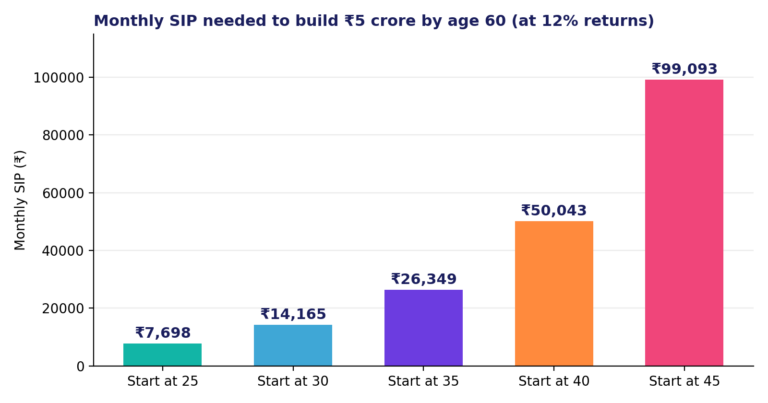
Take a target of ₹5 crore at age 60 with a 12 per cent annual return from equity mutual funds. Someone who begins at 25 needs a SIP of only about ₹7,700 a month. Wait until 45, and that same goal demands nearly ₹99,000 a month. Returns are never guaranteed, but the pattern is clear: every year of delay costs you dearly.
Where Should Your Retirement Money Go?
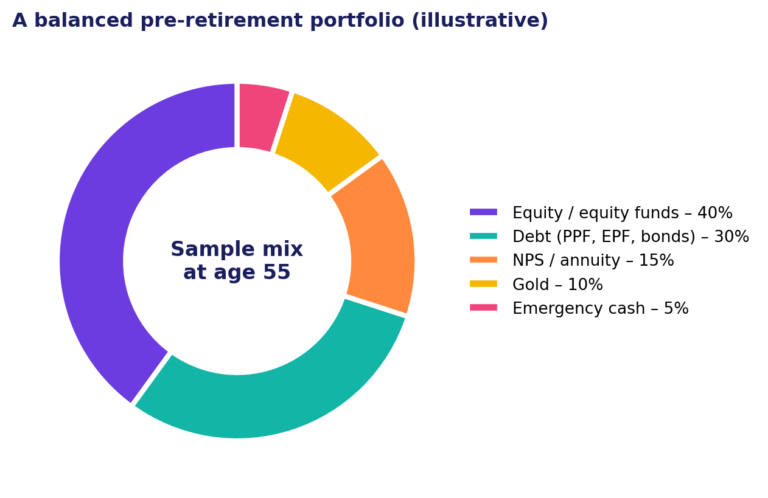
No single product can carry your entire retirement. A healthy mix balances growth with safety. Equity funds beat inflation over the long run, while EPF, PPF and the National Pension System (NPS) bring stability and tax benefits. Gold works as a hedge, and an emergency fund covers surprises.
Five Mistakes That Derail Retirement Plans
– Ignoring inflation. A fixed deposit alone rarely beats rising prices after tax.
– Skipping health insurance. One hospital stay can drain a lifetime of savings.
– Dipping into the corpus early. Withdrawing for weddings or cars breaks compounding.
– Depending on children. Support is lovely, but it should never be the plan.
– Starting “next year.” As Figure 3 shows, next year costs more than this year.
Your 30-Day Retirement Action Plan
Reading is the easy part. Here is how to turn this guide into progress over the next month:
Week 1: List your monthly expenses and decide the age you want to retire.
Week 2: Calculate your corpus using the 25x formula and note the gap from your current savings.
Week 3: Start or increase a SIP, and automate it so you never have to remember.
Week 4: Review your health and term insurance, and name nominees everywhere.
Even a modest start counts. You can raise your SIP by 10 per cent every year as your income grows, a habit that quietly shrinks the monthly burden of your goal.
Frequently Asked Questions (FAQs)
-
1. How much money do I need to retire comfortably in India?
Your retirement corpus depends on your expenses, lifestyle, inflation, and retirement age.
-
2. How does inflation affect retirement planning?
Inflation increases living costs and reduces the purchasing power of your savings.
-
3. When should I start planning for retirement?
Start as early as possible to benefit from compounding and build a sufficient retirement fund.
-
4. Which investments are best for retirement planning in India?
EPF, PPF, NPS, mutual funds, and fixed-income investments can help build your retirement corpus.
Conclusion
Retiring comfortably in India usually needs a corpus of 25 to 30 times your annual expenses at retirement, which for many families means anywhere between ₹5 crore and ₹15 crore. The good news is that you do not have to find it all at once. Start early, invest through SIPs, protect your health, and review your plan every year. Small, steady steps beat big, late panic every time.
👉 Not sure whether to buy or rent in your city? Let Unicorn Finances run the numbers for your exact situation.
Leave A Comment