

Money is one of the biggest sources of stress — and one of the biggest sources of strength — in a relationship. Whether you’ve just moved in together, recently got engaged, or have been married for years, financial planning for couples isn’t a one-time conversation. It’s an ongoing habit that protects your relationship as much as your bank balance. This guide from Unicorn Finance breaks down exactly where to start, step by step.
Why Financial Planning for Couples Matters
Studies consistently show that money disagreements are among the top predictors of relationship strain. The good news? Most of that friction comes from a lack of a shared system, not a lack of love. A clear, honest financial plan removes guesswork, reduces arguments, and helps both partners work toward the same goals instead of pulling in different directions.
Step 1: Have an Honest Money Conversation
Before you touch a spreadsheet or open a joint account, sit down and talk. This is the foundation every couple’s financial plan is built on.
Discuss Your Financial History and Goals
Share your income, existing debts (student loans, credit cards, personal loans), credit scores, and any recurring obligations. There should be no surprises six months into the relationship. Talk about your short-term wants (a vacation, a new phone) and long-term dreams (a house, early retirement, children’s education).
Understand Each Other’s Money Mindset
People generally fall into ‘saver’ or ‘spender’ tendencies shaped by how they were raised. Neither is wrong — but naming the pattern helps you design a system that works for both of you rather than one that quietly resents the other. Investopedia’s guide to money personalities is a useful starting point if you want a framework for this conversation.
Step 2: Choose Your Banking Structure — Joint vs Separate Accounts
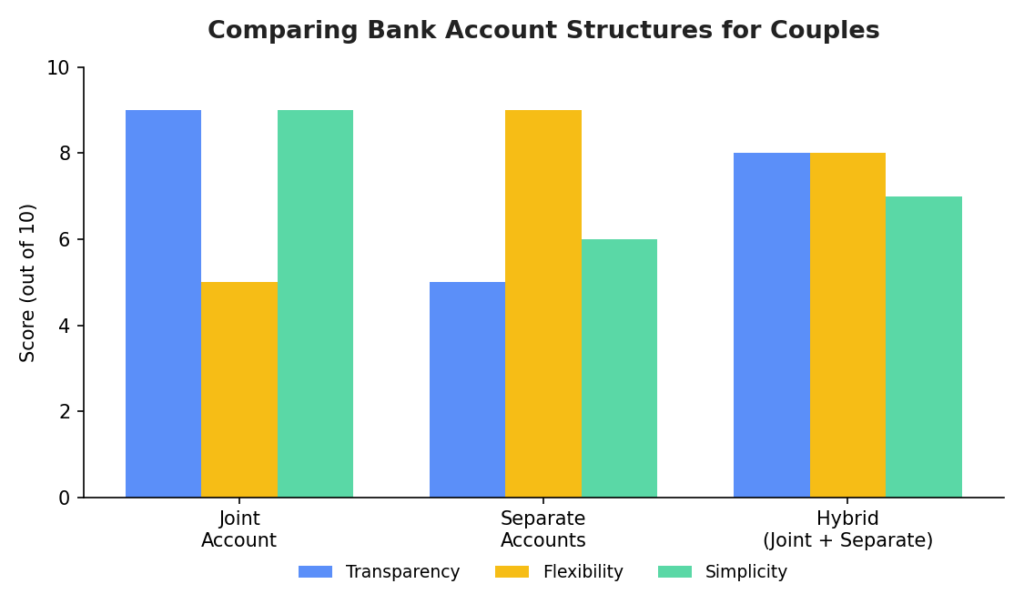
There’s no universally ‘correct’ answer here — only what fits your relationship. Most couples land on one of three models:
Joint Accounts
Everything goes into one pool. This maximises transparency and simplicity, and works well once both partners fully trust the shared system.
Separate or Hybrid Accounts
Each partner keeps individual accounts for personal spending, with a joint account funded by both for rent, groceries, and shared goals. This hybrid model is increasingly popular because it preserves financial independence while still enabling joint planning.
Step 3: Build a Shared Household Budget
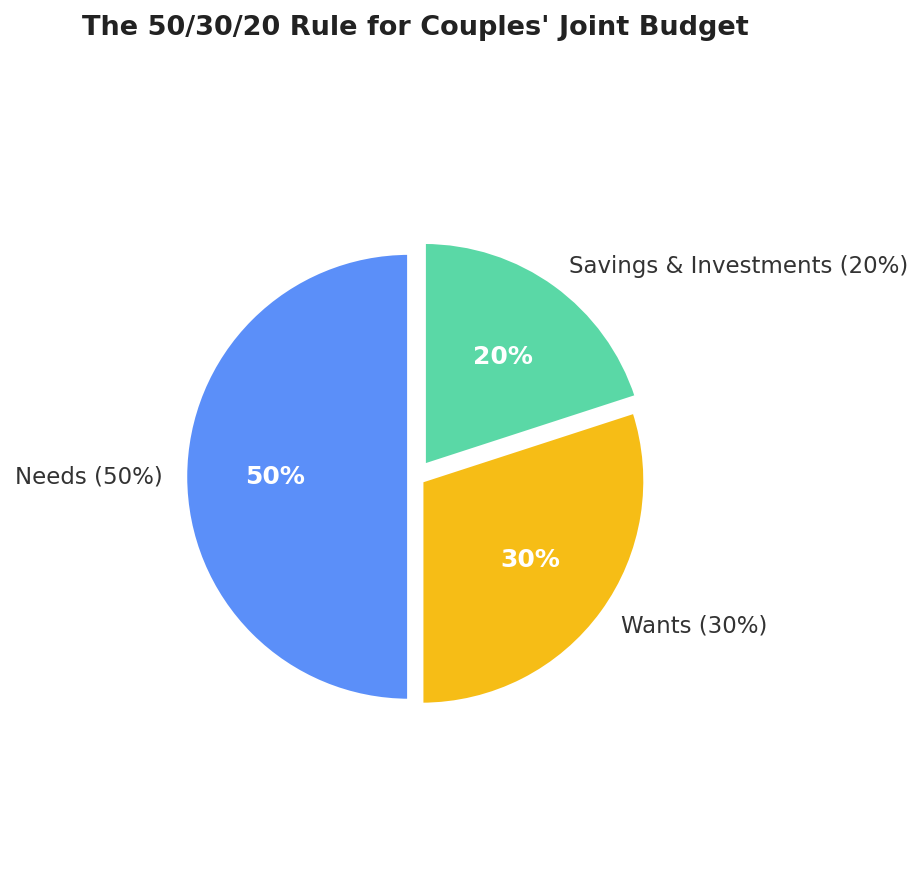
Once money is flowing into a shared structure, you need a budget both partners actually follow. A simple, proven starting point is the 50/30/20 rule: 50% of combined income to needs, 30% to wants, and 20% to savings and investments.
For a deeper walkthrough of building this out month by month, see our Unicorn Finance guide to couple budgeting templates, which includes a downloadable tracker.
Step 3: Build a Shared Household Budget
Once money is flowing into a shared structure, you need a budget both partners actually follow. A simple, proven starting point is the 50/30/20 rule: 50% of combined income to needs, 30% to wants, and 20% to savings and investments.
For a deeper walkthrough of building this out month by month, see our Unicorn Finance guide to couple budgeting templates, which includes a downloadable tracker.
Step 4: Set Joint Financial Goals
Short-Term Goals (0–2 Years)
An emergency fund covering 3–6 months of expenses, paying off high-interest debt, or saving for a wedding or vacation.
Long-Term Goals (3+ Years)
A home down payment, children’s education, or retirement. Write these down together and revisit them every quarter — goals that live only in conversation tend to quietly disappear. Our guide to setting SMART financial goals walks through a simple template for this.
Step 5: Plan for Emergencies and Insurance
Life insurance, health insurance, and an emergency fund are non-negotiable once finances are intertwined. If one partner depends on the other’s income, term life insurance is one of the most cost-effective ways to protect that dependency. The RBI’s financial literacy resources are a solid, India-specific reference for understanding insurance and savings basics.
Step 6: Invest Together for the Future
Once your emergency fund and insurance are in place, start investing as a couple — mutual funds via SIPs, retirement accounts, or index funds, depending on your goals and risk appetite. Review your portfolio together at least twice a year. Check out Unicorn Finance’s beginner’s guide to mutual fund investing if you’re just getting started.
Common Mistakes Couples Make in Financial Planning
Avoiding money conversations until there’s a problem, keeping secret debts or purchases, not revisiting the budget as income changes, and failing to name beneficiaries on insurance and investment accounts are the most common — and most avoidable — mistakes couples make.
Conclusion
Financial planning for couples isn’t about controlling each other’s money — it’s about building a shared vision and a system that supports it. Start with an honest conversation, choose an account structure you both trust, build a simple budget, and grow your goals from there. Small, consistent steps compound into real financial security.
Ready to build your couple’s financial plan?
Talk to a Unicorn Finance advisor for a free, personalised financial plan for you and your partner. Book your free consultation today →
Leave A Comment