

A job loss. A medical emergency. A sudden car repair. Life doesn’t send a calendar invite before things go wrong — and without a financial cushion, one bad month can turn into years of debt. That’s exactly what an emergency fund protects against. But “save 6 months of expenses” is generic advice that doesn’t fit everyone. In this blog, we’ll walk through a simple emergency fund calculator formula so you know exactly how much you need, and where to keep it.
What Is an Emergency Fund and Why Do You Need One?
An emergency fund is money set aside purely for genuine emergencies — job loss, medical crises, urgent home or vehicle repairs, or sudden family obligations. It’s not meant for vacations, gadget upgrades, or “good deals” you don’t want to miss. The goal is simple: give yourself enough runway to handle a crisis without touching your investments, taking on high-interest debt, or panic-selling assets at the wrong time.
– Prevents you from breaking long-term investments during a crisis
– Keeps you out of high-interest debt traps like credit cards or personal loans
– Reduces financial stress and gives you room to make calmer decisions
– Acts as a buffer during income disruptions like layoffs or business slowdowns
How Much Should Your Emergency Fund Actually Be?
The commonly quoted “3 to 6 months of expenses” rule is a reasonable starting point, but your ideal number depends heavily on your income stability, dependents, and existing financial safety nets.
Factors That Increase Your Ideal Emergency Fund
– Irregular or variable income (freelancers, business owners, commission-based roles)
– Being the sole earner in the household
– Dependents such as children, ageing parents, or a non-earning spouse
– No employer-provided health insurance or inadequate personal health cover
– High existing EMIs or loan obligations
– Working in a volatile industry or a company with layoff history
Emergency Fund Calculator: The Simple Formula
Emergency Fund = Monthly Essential Expenses × Number of Months of Cover Needed
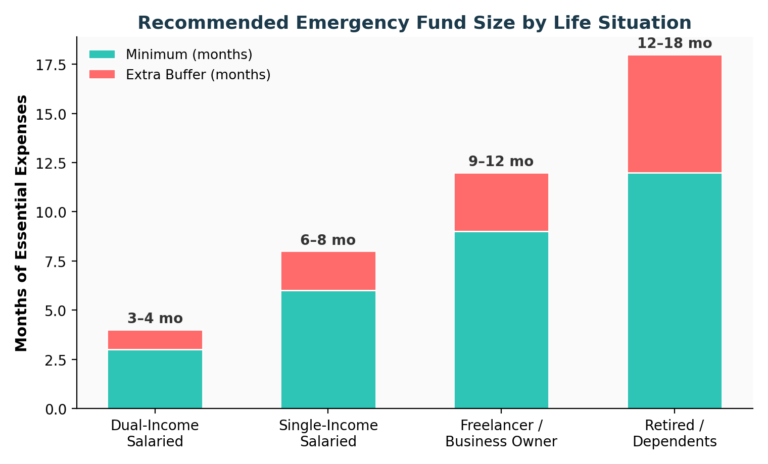
Recommended Months of Cover by Life Situation
The “right” number of months varies significantly depending on your income stability and responsibilities:
Step-by-Step: How to Calculate Yours
– List only essential monthly expenses — rent/EMI, groceries, utilities, insurance, loan payments
– Exclude discretionary spending like dining out, subscriptions, and shopping
– Add up the total to get your monthly essential expense figure
– Multiply by the number of months that fits your risk profile (see chart above)
Round up, not down — it’s better to over-save slightly than fall short
Sample Emergency Fund Calculation
Let’s say a salaried individual with a stable dual-income household has the following essential monthly expenses:
Monthly Essential Expense | Amount (₹) | Notes |
Rent / EMI | ₹20,000 | Fixed, unavoidable |
Groceries & Utilities | ₹12,000 | Essential only |
Insurance Premiums | ₹3,000 | Health + term cover |
Transport & Fuel | ₹4,000 | Commute, essentials |
Loan EMIs (other) | ₹6,000 | Car/personal loan |
Total Monthly Essentials | ₹45,000 | Base for calculation |
Emergency Fund Needed = ₹45,000 × 4 months = ₹1,80,000
This is the target amount to build up in a safe, liquid instrument — not a number to invest in equity or lock away in a long-term FD.
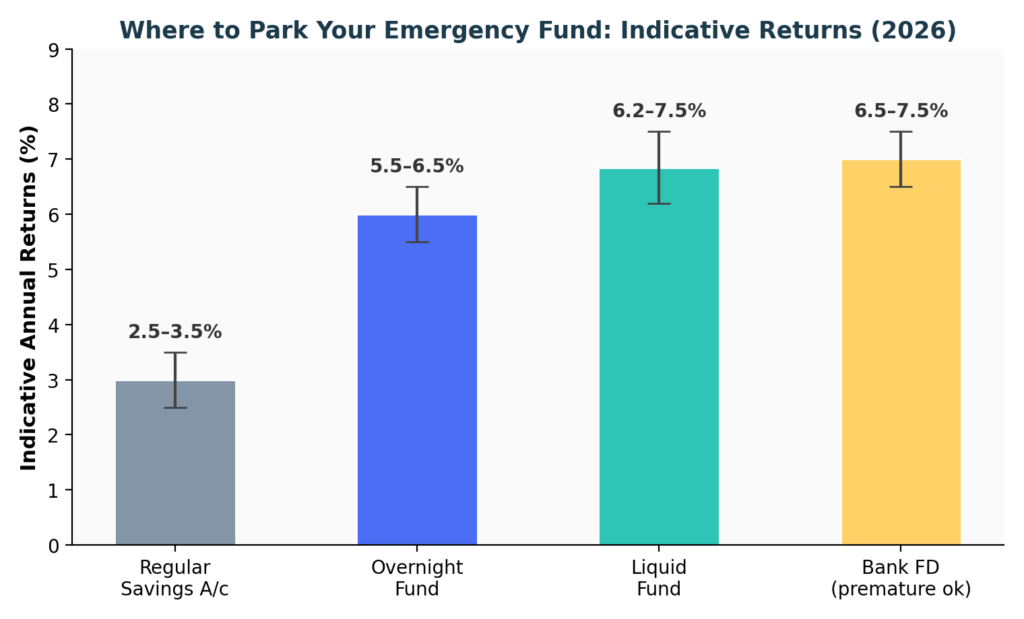
Where Should You Keep Your Emergency Fund?
Your emergency fund needs two things above all else: instant or near-instant access, and capital safety. Returns matter, but only after those two boxes are ticked.
Best Practices for Storing Emergency Funds
– Split the fund: keep 1–2 months in a savings account for instant access, and the rest in liquid or overnight mutual funds for slightly better returns
– Avoid locking the entire fund in a long-tenure FD with heavy premature withdrawal penalties
– Never invest emergency money in equity, crypto, or any market-linked instrument with volatility
– Keep the fund in a separate account so you’re not tempted to dip into it for non-emergencies
Frequently Asked Questions (FAQs)
-
Q1. Should my emergency fund include EMIs and insurance premiums?
Yes — count only non-negotiable monthly outflows like rent, EMIs, groceries, utilities, and insurance premiums, not discretionary spending.
-
Q2. Is a credit card limit a substitute for an emergency fund?
No. Credit cards charge high interest and can be revoked or reduced without notice — they're not a reliable emergency safety net
-
Q3. Should I invest my emergency fund in equity mutual funds for better returns?
No. Equity can lose value exactly when you need cash most. Stick to liquid funds, FDs, or savings accounts for this money.
Conclusion
An emergency fund isn’t about hitting an arbitrary number — it’s about giving yourself genuine breathing room when life throws a curveball. Use the formula above to calculate a figure that actually fits your income stability and responsibilities, park it somewhere safe and liquid, and treat it as untouchable until a real emergency hits. Once that foundation is in place, every other financial goal becomes far less stressful to pursue.
Not sure how to structure your emergency fund alongside your other financial goals? Let Unicorn Finances help you build a complete financial safety net.
Talk to a Unicorn Finance advisor for a free, personalised financial plan for you and your partner. Book your free consultation today →
Leave A Comment