

Getting started with investing is exciting — but it’s also where most costly habits are formed. Nearly every new investor makes at least one of these errors in their first few years, often without realising it until the damage is done. The good news is that almost every one of these investment mistakes for beginners is completely avoidable once you know what to watch for. In this guide, Unicorn Finance breaks down the seven mistakes we see most often, why they happen, and exactly how to sidestep each one — so your money can start compounding in the right direction from day one.
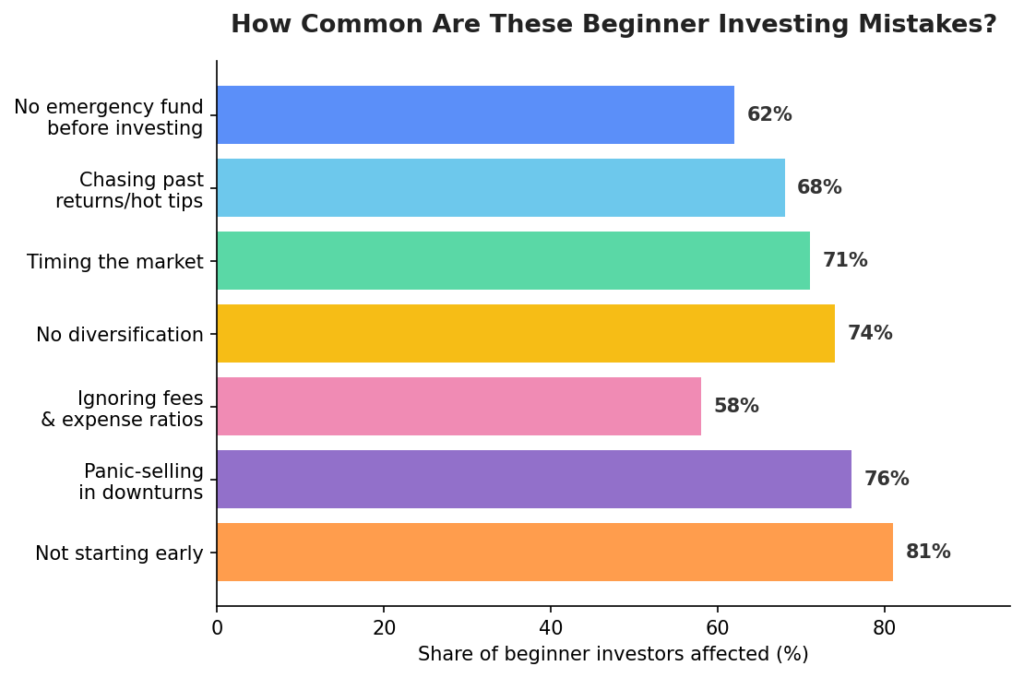
1. Not Starting Early Enough
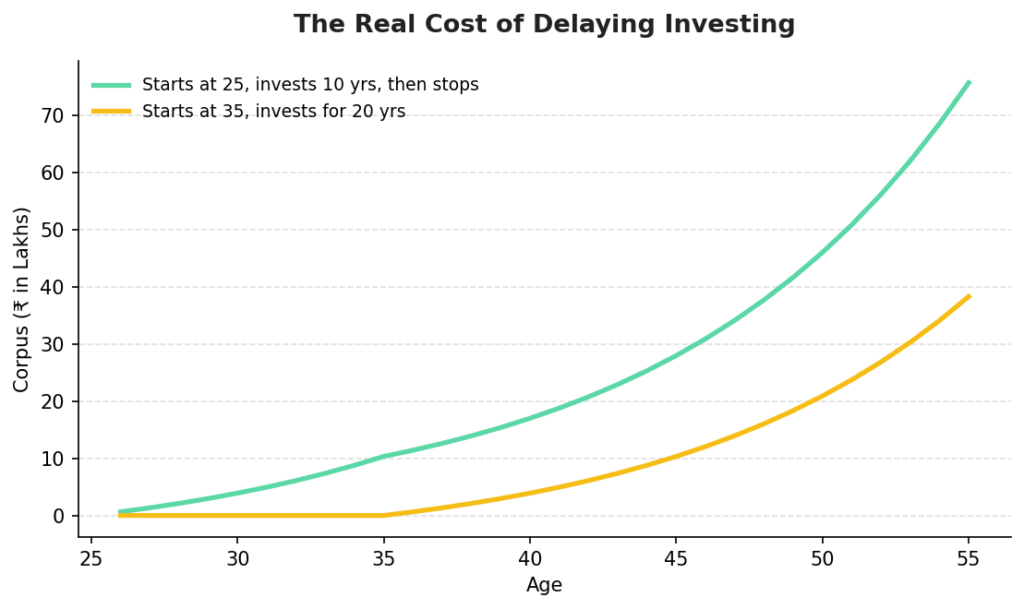
Time in the market beats timing the market. Thanks to compounding, an investor who starts at 25 and stops after just 10 years can end up with nearly double the corpus of someone who starts at 35 and invests for twice as long. Every year you delay isn’t just a year of missed contributions — it’s a year of missed growth on all the years that came before it.
Why This Happens
Most beginners assume they need a large sum of money or perfect market conditions before they can start. In reality, waiting for the ‘right time’ almost always costs more than starting small, immediately, with whatever amount is comfortable.
How to Avoid It
Start with even a small monthly amount the day you have surplus income, and increase it as your income grows. For a walkthrough of how compounding works in practice, see our Unicorn Finance guide to the power of compounding.
2. Skipping the Emergency Fund
Investing before you have 3–6 months of expenses set aside is one of the most common beginner traps. Without a cash buffer, a sudden expense — a job loss, medical bill, or urgent repair — can force you to sell investments at the worst possible time, often during a market dip, locking in losses that a little planning could have avoided entirely.
Why This Happens
Investing feels more productive than ‘just’ parking money in a savings account, so beginners often skip the unglamorous step of building a safety net first.
How to Avoid It
Keep your emergency fund in a liquid instrument like a savings account or liquid fund, separate from your investment accounts, and treat it as untouchable except for genuine emergencies. Only once this is fully funded should the rest of your surplus flow into long-term investments.
3. Chasing Past Returns and Hot Tips
A stock or fund that performed brilliantly last year is not guaranteed to repeat that performance — in fact, past outperformance often reverts toward the average. Beginners frequently pile into whatever is trending on social media or in a friend’s WhatsApp group, only to buy in right as the price peaks and early gains fade. SEBI’s investor awareness resources are a good, India-specific place to learn how to evaluate an investment on fundamentals rather than hype.
Why This Happens
Recent performance is the easiest thing to see and the hardest thing to ignore. It feels safer to buy something that has ‘already proven itself,’ even though that proof says little about future returns.
How to Avoid It
Judge an investment by your own goals, time horizon, and risk appetite — not by how well it did last quarter. If a recommendation comes with urgency (‘buy now before it’s too late’), treat that urgency itself as a warning sign.
4. Trying to Time the Market
Waiting for the ‘perfect’ entry point usually means waiting forever, or jumping in right before a downturn. Even professional fund managers struggle to consistently time market highs and lows — expecting a beginner to do it reliably sets up an almost guaranteed loss of both money and confidence.
Why This Happens
Financial media and social feeds are full of confident predictions about where the market is ‘about to go,’ which makes waiting feel like a rational strategy. In hindsight, though, most of those predictions turn out to be wrong, and the cost of waiting is usually higher than the cost of being invested through a dip.
How to Avoid It
A Systematic Investment Plan (SIP) that invests a fixed amount on a fixed schedule removes this guesswork entirely. It automatically buys more units when prices are low and fewer when prices are high, smoothing out your average purchase price over time without you having to predict anything.
5. Skipping Diversification
Putting all your money into a single stock, sector, or asset class multiplies your risk far beyond what most beginners realise. A well-diversified portfolio spreads investments across equity, debt, and possibly gold or real estate, so a downturn in one area doesn’t sink your entire plan. Our guide to building a diversified portfolio breaks this down by risk appetite and life stage.
Why This Happens
It’s tempting to concentrate money in a single ‘sure thing’ — a company you work for, a sector that’s currently booming, or a coin a friend swears by. Concentration can amplify gains, but it amplifies losses just as easily, and beginners rarely have the capital cushion to absorb a concentrated loss.
How to Avoid It
A simple starting point is a mix of diversified equity mutual funds, a debt component for stability, and no single holding that represents more than a small fraction of your total portfolio.
6. Ignoring Fees and Expense Ratios
A 1–2% difference in annual fees sounds small but compounds into a significant drag on returns over 20–30 years — on a large corpus, that gap alone can amount to years’ worth of contributions. Always check a fund’s expense ratio and compare it against similar options before investing. Investopedia’s explainer on expense ratios is a useful primer if you’re comparing funds for the first time.
How to Avoid It
Before investing in any fund, check its total expense ratio (TER) alongside its historical performance and portfolio composition. Low-cost index funds are often a smart default for beginners precisely because their fees are structurally lower than actively managed alternatives.
7. Panic-Selling During Downturns
Markets fall — that’s normal, not a signal to abandon your plan. Beginners who panic-sell during a correction typically lock in losses and then miss the recovery that follows, turning a temporary paper loss into a permanent real one. If your goals and time horizon haven’t changed, a market dip usually isn’t a reason to change your strategy.
How to Avoid It
Revisit your original goal and time horizon before making any decision during a downturn. If both are unchanged, the most productive action is often no action at all — or, for the more disciplined investor, continuing to invest through the dip at lower prices.
Quick Recap: The 7 Mistakes at a Glance
- Not starting early enough — delay is the most expensive mistake of all.
- Skipping the emergency fund before investing.
- Chasing past returns and hot tips instead of fundamentals.
- Trying to time the market instead of investing consistently.
- Skipping diversification across asset classes.
- Ignoring fees and expense ratios.
Panic-selling during market downturns.
FAQs
How much money do I need to start investing?
You can start a SIP with a very small monthly amount through most mutual fund platforms in India. The right amount matters less than starting consistently and increasing it as your income grows.
Is it better to invest a lump sum or through SIPs as a beginner?
For most beginners, SIPs are easier to sustain and reduce the risk of poor market timing, since they spread purchases across highs and lows automatically.
What should I do if my portfolio is down right now?
Revisit your original goal and time horizon first. If neither has changed, avoid making decisions purely based on short-term price movements.
How many funds or stocks do I need to be diversified?
There’s no magic number, but for most beginners, 3–5 well-chosen mutual funds across different categories (large-cap, mid-cap, and debt, for example) offer meaningfully better diversification than a large number of overlapping funds that all hold similar underlying stocks.
Conclusion
Avoiding these seven mistakes won’t guarantee outsized returns, but it will keep you from losing money to your own habits — which is often the bigger risk for beginners than the market itself. Start early, build your safety net, diversify, keep costs low, and stay invested through the noise. Small, disciplined decisions made consistently are what actually build wealth over time.
Ready to start investing the right way?
Get a free, personalised investment plan from a Unicorn Finance advisor. Book your free consultation today →
Leave A Comment