

Building wealth is not simply about choosing investments or chasing the highest returns. It is about making sure your money is ready when life asks you to take an important step. Buying a home, funding a child’s education, starting a business, travelling, supporting parents and retiring comfortably are all milestones that need thoughtful preparation.
Goal-based financial planning connects each financial goal with a target amount, a time horizon and an investment approach. Instead of investing without direction, you give every part of your savings a clear purpose. For individuals and families in India, this can make financial decisions more organised, measurable and easier to review.
What Is Goal-Based Financial Planning?
Goal-based financial planning is a method of organising your finances around specific life goals. Each goal is defined by what you want to achieve, how much it may cost, when you need the money and how much risk you can reasonably take.
For example, a down payment for a home in three years is different from retirement planning that may be 25 years away. The amount, investment horizon and ability to handle market fluctuations are not the same. A single investment strategy may therefore not be suitable for every goal.
The Securities and Exchange Board of India (SEBI) also highlights the importance of clearly defining financial needs in terms of the amount required and the date when the money will be needed
Why Should You Plan Around Life’s Milestones?
1. It gives your investments a clear purpose
When you know what you are investing for, it becomes easier to decide how much to invest and how long to stay invested. A monthly SIP can become part of a specific plan for higher education or retirement rather than an isolated transaction.
2. It helps you prepare for inflation
The cost of education, housing, healthcare and everyday living can rise over time. A goal that costs ₹10 lakh today may require a higher amount several years from now. Your plan should estimate the future cost instead of relying only on today’s price.
3. It supports better financial discipline
Separating goals can help reduce the temptation to use long-term investments for short-term spending. It also makes progress easier to track and encourages regular contributions.
4. It helps balance risk and time
Money needed soon generally calls for greater focus on liquidity and capital stability. Long-term goals may have more time to absorb market ups and downs, depending on your risk profile. The right mix should be assessed goal by goal.
How to Build a Goal-Based Financial Plan
Step 1: List your important life goals
Start by writing down your goals. Include essential needs as well as aspirations. Common goals for Indian households include:
-Building an emergency fund
-Buying a home or making a home-loan down payment
-Funding children’s school and higher education
-Planning a wedding or a major family event
-Starting or expanding a business
-Supporting parents and managing healthcare needs
-Building a retirement corpus and leaving a financial legacy
Step 2: Estimate the future cost of each goal
Write down the current estimated cost and the year in which you expect to need the money. Then account for inflation. The future value of a goal can be estimated using a reasonable inflation assumption, but remember that actual costs may differ.
For illustration, if a goal costs ₹10 lakh today and costs rise by an assumed 6% each year, the estimated cost after 10 years would be about ₹17.9 lakh. This is an example, not a forecast or guaranteed figure.
Step 3: Prioritise goals by timeline
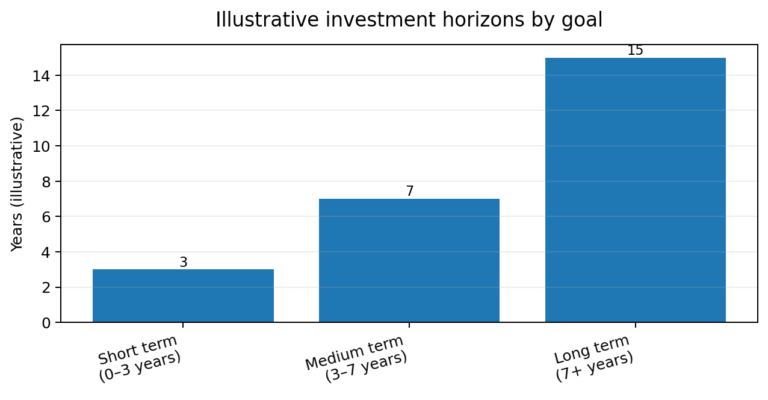
Classify goals by when you need the money. The ranges below are broad planning guides; your circumstances may call for different categories.
Time horizon | Examples | Planning focus |
Short term: up to 3 years | Emergency reserve, near-term fees, planned purchase | Liquidity and capital stability |
Medium term: 3–7 years | Home down payment, business capital | Balance growth needs with risk capacity |
Long term: more than 7 years | Higher education, retirement, wealth creation | Long-term asset allocation and discipline |
Step 4: Assess your income, expenses and protection needs
Before committing to investments, understand your monthly cash flow, existing loans, savings and dependants’ needs. Build an adequate emergency reserve and review suitable health and life insurance protection. High-cost debt may also need attention before increasing long-term investment commitments.
Step 5: Match investments to each goal
Different goals may need different investment approaches. Mutual funds offer categories such as equity, debt and hybrid funds, each with different risk characteristics. Equity-oriented investments can experience substantial short-term volatility. Debt-oriented options also carry risks, including interest-rate and credit risk. Do not select a fund only because it recently delivered high returns.
A Systematic Investment Plan (SIP) is a way to invest a fixed amount at regular intervals. It can encourage discipline, but it does not guarantee profits or protect against losses. The choice of scheme and asset allocation should reflect your goal, investment horizon and risk tolerance.
Explore Mutual Funds & SIPs and complete financial planning through Unicorn Finances to understand how a structured approach may fit into your overall plan.
Step 6: Review and rebalance your plan
Life changes. Your salary may increase, a new family responsibility may arise, a goal may move closer or market movements may change your portfolio allocation. Review your plan periodically and whenever a major life event occurs. Revisit the target amount, timeline, contributions and asset mix.
A Simple Example: Planning for Three Goals
Imagine a family planning for a home down payment in four years, a child’s higher education in 12 years and retirement in 25 years. These goals should not automatically be funded from one undifferentiated portfolio. The family can estimate each future cost, decide how much it can invest and evaluate suitable investment categories separately. A financial professional can help assess the trade-offs and keep assumptions realistic.
Common Mistakes to Avoid
-Investing without defining the purpose or date of the goal.
-Ignoring inflation and underestimating future costs.
-Taking more risk than you can financially or emotionally manage.
-Depending on past returns as a promise of future performance.
-Stopping investments in response to every market movement.
-Failing to review nominations, insurance and emergency savings.
Where Should You Keep Your Emergency Fund?
Q – Is goal-based financial planning suitable for beginners?
A – Yes. Beginners can start by listing a few priority goals, understanding monthly cash flow and setting a realistic contribution. A plan can become more detailed as income and experience grow.
Q – Can I use mutual funds for every financial goal?
A -Not necessarily. Mutual funds include different categories and carry market-related risks. The right choice depends on the time horizon, risk capacity, liquidity needs and suitability of the investor.
Q – How much should I invest every month?
A – There is no single amount that works for everyone. Estimate the future cost of each goal, account for existing savings and decide on a contribution that fits your budget and risk profile.
Q – How often should I review my financial plan?
A – A yearly review is a useful starting point. Review sooner when income, family responsibilities, goals or financial circumstances change.
Q – Does a SIP guarantee returns?
A – No. A SIP is an investment method, not a return guarantee. Mutual fund investments are subject to market risks; read scheme documents carefully.
Conclusion: Give Every Investment a Purpose
A strong financial future is built through clear goals, realistic estimates, suitable investments and consistent reviews. Whether you are planning for a home, your child’s education or a comfortable retirement, start by understanding what matters most and when you will need the money. Then build a plan that reflects your income, responsibilities and comfort with risk.
Plan Your Next Milestone with Unicorn Finances
Unicorn Finances is an AMFI-registered mutual fund distributor based in Pune, offering goal-based investment planning, mutual fund and SIP support, risk profiling, portfolio design and ongoing reviews. If you want to bring more clarity to your financial goals, connect with the team for a consultation.
Leave A Comment